

Natural Resource Management from a Political Ecology Perspective
Natural Resource Management from a Political Ecology Perspective
Natural Resource Management from a Political Ecology Perspective
Tropical forests and lands are places of life for the people who live there, objects of management and conservation for governments, sites for businesses, and means of climate change mitigation for the international community. Focusing on the question, "Whose is nature/resources?", we study the relationships of various stakeholders (actors) surrounding the same natural resources from the perspective of political ecology.
What is political ecology?
Political ecology is an interdisciplinary field of study that examines environmental problems such as deforestation and land disputes not only from a natural perspective, but also from a social and political perspective, considering access to resources, rights, and power relations (Robbins 2019). It is characterized by its focus on the interests and power dynamics of various actors, including states, corporations, environmental NGOs, and grassroots groups, when interpreting environmental problems (Bryant and Bailey 1997). Furthermore, whether people benefit from resources depends not only on legal rights, but also on capital, technology, markets, knowledge, and social relations (Ribot and Peluso 2003). Political ecology questions "to whom and how" the benefits and burdens of environmental change are distributed, and clarifies how policies and development projects affect the lives of people on the ground.
Even the same forest can look different depending on one's perspective.
For example, even in forests designated as protected areas, local residents have traditionally lived there, obtaining firewood, food, and cash income. On the other hand, for the government (forestry agency), it is a target for management, where illegal logging and cultivation should be cracked down on. Private companies use it for timber production and plantations, environmental NGOs see it as a treasure trove of biodiversity, aid agencies see it as a place to balance forest conservation with improving the livelihoods of residents, and the international community sees it as a CO2 sink. Each finds different values in the same forest. These differences in perspective create coordination and friction regarding the use and management of resources.
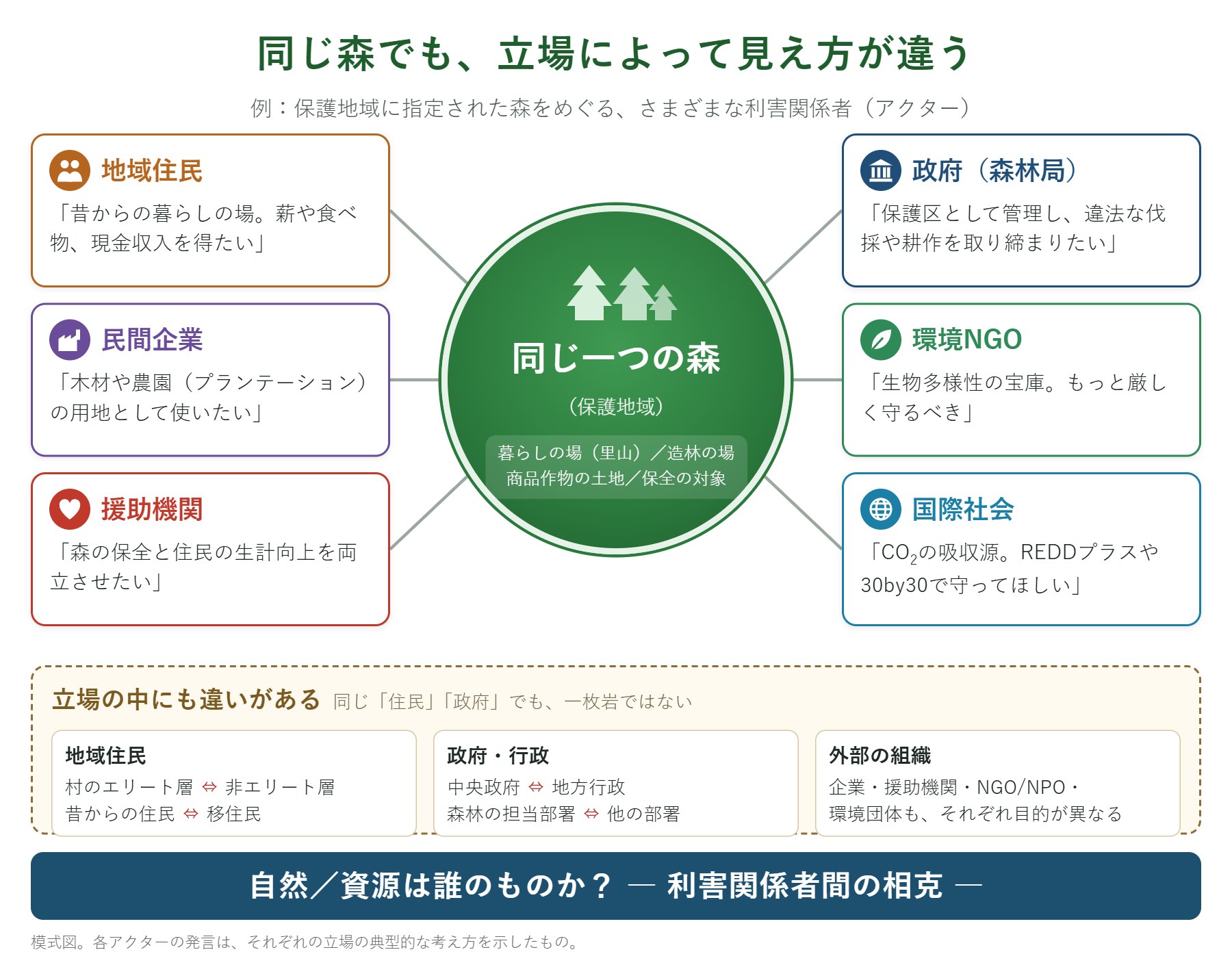
Differences within each group
"Local residents" and "governments" are not monolithic entities. The view that a local "community" is a single, unified entity with shared interests has long been criticized (Agrawal and Gibson 1999). Even within a village, there are elites and non-elites, long-time residents and newcomers. Within the government, there are differences in positions and interests between the central government and local administrations, and between departments responsible for forestry and other departments. We pay attention to these differences within the actors, and through on-site interviews and observations, we clarify how policies are implemented on the ground, who benefits and who suffers.
Current research topics
- Community-based forest management in Thailand and Laos: Based on the discussion of "commons" (Inoue 2004), where local people jointly utilize and manage resources, I am researching how forest management led by local residents is implemented in relation to the government and external organizations, and whose lives and rights are connected to it.
- Dividing and owning a forest (territorialization): The concept of "territorialization," where a state divides territory and manages the use of land and resources, has been discussed based on the example of Thailand (Vandergeest and Peluso 1995). We are researching in Thailand and Laos the process by which forests are divided and become the property of someone through the designation of protected areas and land/forest divisions, and the impact this has on the resource use of local residents. Hyakumura (2021) presents the results of a comparative study between Laos and Japan.
Previous research
To date, my research has focused on the relationships between stakeholders regarding resources, including Laos' protected area management policies, land and forest allocation projects, and changes in land and forest use by local residents (Hyakumura 2013; Boutthavong et al. 2016), actor relationships surrounding afforestation and plantation development (Hyakumura 2015a, 2015b), conflict avoidance regarding community forestry and common lands of ethnic minorities, the territorialization of forests in Laos and Japan (Hyakumura 2021), changes in the livelihoods of local residents accompanying tourism development in China (Hyakumura et al. 2020), and the granting of forest land concessions, land grabbing, and the rights of ethnic minorities in Bangladesh (Islam and Hyakumura 2019, 2021).
Main publications and books from the research lab
- Islam, K. K., & Hyakumura, K. (2021). The potential perils of Sal forests land grabbing in Bangladesh: An analysis of economic, social and ecological perspectives. Environment, Development and Sustainability, 23, 15368–15390. https://doi.org/10.1007/s10668-021-01301-7
- Hyakumura Kimihiko(2021)「森を区切り、所有する:ラオスと日本における領域化」、『森のつくられかた 移りゆく人間と自然のハイブリッド』、共立出版、72–95頁
- Hyakumura Kimihiko・許思寒・Onda Nariaki(2020)「中国・剣門関観光景区の本格整備に伴う地域住民の生業への影響」、『日本森林学会誌』102(4)、232–238頁 https://doi.org/10.4005/jjfs.102.232
- Islam, K. K., & Hyakumura, K. (2019). Forestland Concession, Land Rights, and Livelihood Changes of Ethnic Minorities: The Case of the Madhupur Sal Forest, Bangladesh. Forests, 10(3), 288. https://doi.org/10.3390/f10030288
- Boutthavong, S., Hyakumura, K., Ehara, M., & Fujiwara, T. (2016). Historical Changes of Land Tenure and Land Use Rights in a Local Community: A Case Study in Lao PDR. Land, 5(2), 11. https://doi.org/10.3390/land5020011
- Hyakumura, K. (2015a). Forest Resources and Actor Relationships: A Study of Changes Caused by Plantations in Lao PDR. In Collaborative Governance of Forests: Towards Sustainable Forest Resource Utilization (pp. 199–221). University of Tokyo Press.
- Hyakumura, K. (2015b). Laos: Local Communities and Involvement of External Stakeholders. In Multi-level Forest Governance in Asia: Concepts, Challenges and the Way Forward (pp. 307–334). SAGE Publications.
- Hyakumura Kimihiko(2013)「地域住民による土地・森林利用の実態とその変遷―ラオス・サワンナケート県の丘陵地の村落の事例―」、『地域研究』13(1)、151–166頁 https://doi.org/10.24638/jcasreview.13.1_151
Other papers and books are listed on the Publications page.
Related SDGs




References
- Agrawal, A., & Gibson, C. C. (1999). Enchantment and disenchantment: The role of community in natural resource conservation. World Development, 27(4), 629–649. https://doi.org/10.1016/S0305-750X(98)00161-2
- Bryant, R. L., & Bailey, S. (1997). Third World Political Ecology. Routledge.
- 井上真(2004)『コモンズの思想を求めて―カリマンタンの森で考える』岩波書店
- Ribot, J. C., & Peluso, N. L. (2003). A theory of access. Rural Sociology, 68(2), 153–181. https://doi.org/10.1111/j.1549-0831.2003.tb00133.x
- Robbins, P. (2019). Political Ecology: A Critical Introduction (3rd ed.). Wiley-Blackwell.
- Vandergeest, P., & Peluso, N. L. (1995). Territorialization and state power in Thailand. Theory and Society, 24(3), 385–426. https://doi.org/10.1007/BF00993352